

Quick answer
A vehicle identification number (VIN) is the 17-character code that identifies one vehicle and no other. It has three parts: the world manufacturer identifier (WMI, characters 1–3) names the maker and where it is based, the vehicle descriptor section (VDS, characters 4–9) describes the model, and the vehicle identifier section (VIS, characters 10–17) pins down the individual car, usually with its model year, plant and serial number.
The format is set by ISO 3779, in the US by 49 CFR Part 565 and in the EU by Regulation (EU) No 19/2011. Below you’ll find each part decoded, a list of common WMI codes, the country codes, how the check digit works with a worked example, and where to find and scan the VIN on a car.
- 1–3 · Manufacturer (WMI)1HG = Honda, built in the US
- 4–8 · Vehicle descriptorModel, body, engine and restraints, coded by the maker
- 9 · Check digitCatches a mistyped VIN (required in North America)
- 10 · Model year3 = 2003
- 11 · PlantWhere the vehicle was built
- 12–17 · Serial numberIdentifies this one vehicle
The three parts of a VIN: WMI, VDS and VIS
Every 17-character VIN splits the same way. Only the first part is handed out by an outside body; the maker fills in the rest by its own rules, within limits set by the standard and by national law.
| Positions | Section | What it tells you | Who decides it |
|---|---|---|---|
| 1–3 | World manufacturer identifier (WMI) | The maker, and the country or region it is registered in | Assigned by a national authority, coordinated worldwide by SAE International |
| 4–8 | Vehicle descriptor section (VDS) | Model line, body style, engine, restraint systems, weight class | The manufacturer |
| 9 | Check digit (North America) or a further VDS character (elsewhere) | Whether the VIN has been copied correctly | Calculated from the other 16 characters |
| 10 | Vehicle identifier section (VIS) begins: model year | The model year (compulsory in North America) | Fixed code table |
| 11 | VIS: plant | The factory that fitted the VIN | The manufacturer |
| 12–17 | VIS: serial number | The individual vehicle | The manufacturer, in production order |
Only capital letters and the digits 0–9 are allowed, and the letters I, O and Q are never used because they are too easily mistaken for 1 and 0. If a character looks like an O, it’s a zero.
World manufacturer identifier (WMI): characters 1–3
The WMI identifies the manufacturer. The first character gives the region, the first two together usually give the country, and the third separates one maker, brand or vehicle type from another. Volkswagen, for example, uses WVW for passenger cars, WVG for SUVs and multipurpose vehicles and WV1 for commercial vehicles.
WMIs are defined in ISO 3780. A national authority in the country where the manufacturer has its main place of business assigns them, working with SAE International, which keeps the worldwide register. In the US, NHTSA has contracted SAE to assign them directly. Because the code follows the maker’s registered base, a car built by a carmaker’s local company carries that country’s code: a Toyota built by Toyota’s Canadian plant starts 2T, not J.
Small manufacturers: why some VINs have a 9 in position 3
A three-character WMI is reserved for manufacturers that build at least a set number of vehicles a year. Smaller makers share a WMI with a 9 in the third position, and the authority gives them three more characters at positions 12–14 of the VIS. The six characters together identify the maker, which leaves positions 15–17 for the serial number.
- EU and ISO 3780: the threshold is 500 vehicles a year of global production (Regulation (EU) No 19/2011, Annex I, Part B, point 2.2.3).
- United States: the threshold is 1,000 vehicles of a given type a year (49 CFR 565.12 and 565.15). In the US, a 9 in position 3 always means a six-character manufacturer identifier.
So when you see the phrase “manufacturer builds more than 500 vehicles per year”, it describes a maker big enough to have its own three-character WMI.
Vehicle descriptor section (VDS): characters 4–9
The VDS describes the vehicle rather than the individual car. The manufacturer chooses the codes and their order. In the US the VDS has to let anyone with the maker’s decoding data work out, for a passenger car, the make, line, series, body type, engine type and every restraint device and where it sits. Trucks and multipurpose vehicles also have to show the gross vehicle weight rating, and trucks the brake system.
Outside North America the ninth character is often just another VDS character, or a filler. Many European VINs pad unused VDS places with Z: a Volkswagen VIN such as WVWZZZ6RZGU000123 has Z in positions 4–6 and in position 9.
Some people search for this section as the “vehicle description section”, and some decoders call the body-style code inside it the “mfr body code”. It is all the same part of the VIN.
What the 8th character of a VIN means
There is no universal meaning. The 8th character is the last one in the VDS, so the manufacturer decides what it stands for. Many North American makers use it for the engine, but others use it for the restraint system, the trim series or something else. To read it you need that maker’s own decoding data, which US manufacturers have to file with NHTSA and which the free NHTSA VIN decoder uses.
Vehicle identifier section (VIS): characters 10–17
The last eight characters single out the individual vehicle. ISO and EU law call it the vehicle indicator section; “identifier section” is the more common search term. EU law requires the last four characters to be digits. US law requires the last five to be digits for cars and light trucks, and sets the first two: position 10 is the model year and position 11 is the plant.
For the model year, letters and digits run in a 30-year cycle that skips I, O, Q, U, Z and 0. To tell the cycles apart on cars and light trucks, look at position 7: if it is a digit, the year falls between 1980 and 2009; if it is a letter, between 2010 and 2039.
| Code | Year | Code | Year | Code | Year |
|---|---|---|---|---|---|
| A | 2010 | J | 2018 | T | 2026 |
| B | 2011 | K | 2019 | V | 2027 |
| C | 2012 | L | 2020 | W | 2028 |
| D | 2013 | M | 2021 | X | 2029 |
| E | 2014 | N | 2022 | Y | 2030 |
| F | 2015 | P | 2023 | 1–9 | 2031–2039 |
| G | 2016 | R | 2024 | ||
| H | 2017 | S | 2025 |
Outside North America, position 10 does not have to be the model year, although many makers use it that way.
VIN format examples
| Example | How to read it |
|---|---|
1HGCM82633A004352 | North American format. 1HG = Honda, US. Position 9 (3) is a valid check digit. Position 10 (3) = 2003, which fits because position 7 (2) is a digit. A = plant. 004352 = serial number. |
WVWZZZ6RZGU000123 | European format. WVW = Volkswagen passenger car, Germany. Z fills the unused VDS places, and position 9 is a Z, not a check digit. G in position 10 is the year code for 2016. |
XX9 ... ABC 123 (layout) | Small-maker format. A 9 in position 3 means the maker is identified by positions 1–3 plus 12–14, and only positions 15–17 count production. |
List of common WMI codes
These are WMIs you’ll often see on cars in Europe and North America. A manufacturer can hold many WMIs, one per country, brand or vehicle type, so this is a sample, not a full register. SAE International keeps the complete list, and NHTSA’s free vPIC decoder covers every WMI registered for the US market.
| WMI | Manufacturer | Country | Vehicle type |
|---|---|---|---|
| 1FA / 1FT | Ford | United States | Cars / trucks |
| 1G1 | General Motors (Chevrolet) | United States | Cars |
| 1GC | General Motors (Chevrolet) | United States | Trucks |
| 1HG | Honda (American Honda) | United States | Cars |
| 2T1 | Toyota (Canadian plant) | Canada | Cars |
| 3G1 | General Motors (Chevrolet) | Mexico | Cars |
| 3GC | General Motors (Chevrolet) | Mexico | Trucks |
| 3GN | General Motors (Chevrolet) | Mexico | SUVs and MPVs |
| 3GT | General Motors (GMC) | Mexico | Trucks |
| 5YJ | Tesla | United States | Cars |
| JHM | Honda | Japan | Cars |
| JN1 | Nissan | Japan | Cars |
| JTD | Toyota | Japan | Cars |
| KMH | Hyundai | South Korea | Cars |
| KNA | Kia | South Korea | Cars |
| NMT | Toyota (Turkish plant) | Turkey | Cars |
| SAJ | Jaguar (Jaguar Land Rover) | United Kingdom | Cars |
| SAL | Land Rover (Jaguar Land Rover) | United Kingdom | SUVs |
| TMB | Škoda | Czech Republic | Cars |
| VF1 | Renault | France | Cars |
| VF3 | Peugeot | France | Cars |
| VF7 | Citroën | France | Cars |
| W1K / WDD | Mercedes-Benz (W1K on newer cars) | Germany | Cars |
| WAU | Audi | Germany | Cars |
| WBA | BMW | Germany | Cars |
| WP0 | Porsche | Germany | Cars |
| WVW / WVG / WV1 | Volkswagen | Germany | Cars / SUVs and MPVs / commercial vehicles |
| YV1 | Volvo Cars | Sweden | Cars |
| ZFA | Fiat (Stellantis) | Italy | Cars |
| 6ZZ | Not a carmaker: issued by the Australian Government | Australia | Imported vehicles without a usable VIN |
The codes people search for most: 6ZZ, 3G and 3GC, VF7, TMB
- 6ZZ: not a manufacturer. When a vehicle imported into Australia has no valid 17-character VIN (for example, it only has a chassis number), the Australian Government department that approves vehicle imports can issue a VIN starting 6ZZ so that the vehicle can be registered. The 6 is the Oceania range (here, Australia), and ZZ is a placeholder showing this is a substitute VIN for a low-volume or one-off import, not a carmaker’s code.
- 3G: General Motors vehicles built by its Mexican operation. The first character 3 is Mexico, and G is General Motors.
- 3GC: a Chevrolet truck from General Motors’ Mexican operation. The decoding data GM files with NHTSA lists 3GC as a truck WMI.
- VF7: Citroën, France. Its sister brand Peugeot uses VF3.
- TMB: Škoda Auto, Czech Republic. Škoda has used VINs since the 1984 model year.
VIN country codes: how the first character classifies region and country
The first character tells you the region where the manufacturer is registered. The first two characters together usually narrow it to a country.
| First character | Region |
|---|---|
| A–H | Africa |
| J–R | Asia |
| S–Z | Europe |
| 1–5 | North America |
| 6–7 | Oceania |
| 8–9 | South America |
Common VIN country codes
| Code | Country |
|---|---|
| 1, 4, 5 | United States |
| 2 | Canada |
| 3 (most of 3A–3W) | Mexico |
| J | Japan |
| KL–KR | South Korea |
| L | China |
| MA–ME | India |
| NM–NT | Turkey |
| SA–SM | United Kingdom |
| TM (Škoda’s TMB, for example) | Czech Republic |
| VF–VR | France |
| VS–VW | Spain |
| W | Germany |
| YS–YW | Sweden |
| ZA–ZR | Italy |
| 6A–6W | Australia |
| 9A–9E, 93–99 | Brazil |
SAE International revises these allocations from time to time as new manufacturing countries need codes, so check the current SAE register if a code isn’t listed here.
Check digit calculation
In North America the 9th character must be a check digit (49 CFR 565.13). China also requires one. Its job is to catch transcription errors: change a single character and the VIN will usually fail the check. Europe doesn’t require a check digit, so a European VIN that fails the sum isn’t necessarily wrong.
The method, as set out in 49 CFR 565.15(c):
- Give every character a number. Digits keep their own value. Letters use the table below.
- Multiply each value by the weight for its position. Position 9 has a weight of 0, so the check digit itself doesn’t count.
- Add up the 17 results and divide the total by 11.
- The remainder (0–10) is the check digit. A remainder of 10 is written as X.
| Letter values |
|---|
| A=1, B=2, C=3, D=4, E=5, F=6, G=7, H=8 |
| J=1, K=2, L=3, M=4, N=5, P=7, R=9 |
| S=2, T=3, U=4, V=5, W=6, X=7, Y=8, Z=9 |
| Position | 1 | 2 | 3 | 4 | 5 | 6 | 7 | 8 | 9 | 10 | 11 | 12 | 13 | 14 | 15 | 16 | 17 |
|---|---|---|---|---|---|---|---|---|---|---|---|---|---|---|---|---|---|
| Weight | 8 | 7 | 6 | 5 | 4 | 3 | 2 | 10 | 0 | 9 | 8 | 7 | 6 | 5 | 4 | 3 | 2 |
Worked example: checking 1HGCM82633A004352
| Position | Character | Value | Weight | Value × weight |
|---|---|---|---|---|
| 1 | 1 | 1 | 8 | 8 |
| 2 | H | 8 | 7 | 56 |
| 3 | G | 7 | 6 | 42 |
| 4 | C | 3 | 5 | 15 |
| 5 | M | 4 | 4 | 16 |
| 6 | 8 | 8 | 3 | 24 |
| 7 | 2 | 2 | 2 | 4 |
| 8 | 6 | 6 | 10 | 60 |
| 9 | 3 (check digit) | – | 0 | 0 |
| 10 | 3 | 3 | 9 | 27 |
| 11 | A | 1 | 8 | 8 |
| 12 | 0 | 0 | 7 | 0 |
| 13 | 0 | 0 | 6 | 0 |
| 14 | 4 | 4 | 5 | 20 |
| 15 | 3 | 3 | 4 | 12 |
| 16 | 5 | 5 | 3 | 15 |
| 17 | 2 | 2 | 2 | 4 |
| Total | 311 | |||
311 ÷ 11 = 28, remainder 3 (28 × 11 = 308, and 311 − 308 = 3). The check digit should be 3, and position 9 is 3, so the VIN passes.
What a failed check digit tells you
Mistype the 16th character as 6 instead of 5 (1HGCM82633A004362) and the total rises by 3 to 314. The remainder becomes 6, which doesn’t match the 3 in position 9, so the VIN is flagged. On a North American vehicle, a failed check almost always means a typo or a misread character. On a European VIN, check whether the maker uses a check digit at all before drawing any conclusion.
History of the VIN
Carmakers stamped serial numbers on chassis long before there was a standard, but each used its own length and layout. That made the numbers hard to use for registration, insurance and tracing stolen cars across brands and borders.
In the US, NHTSA published a final rule in 1978 that fixed the 17-character format. It applied to vehicles from the 1981 model year, and today it sits in 49 CFR Part 565. The rule also says no two vehicles may share a VIN within 60 years, counting from the 1980 model year. ISO set out an international standard for VINs during the same period.
ISO 3779, ISO 3780 and the EU rules
- ISO 3779 (current edition 2009) sets out the content and structure of the VIN: three sections, 17 characters, and which characters are allowed.
- ISO 3780 (current edition 2009) covers the world manufacturer identifier and how WMIs are assigned.
- ISO 4030 covers where the VIN is placed on the vehicle and how it is attached.
- Regulation (EU) No 19/2011 makes the VIN a type-approval requirement in the EU. The VIN must be marked on the chassis or body when the vehicle leaves the production line, be unique, and stay traceable by the manufacturer for 30 years. Characters stamped on the chassis must be at least 7 mm high.
Chassis number vs VIN: what’s the difference?
For almost every modern car they are the same thing. “Chassis number” is the older name, from the days when the maker’s serial number was stamped on the frame. Today the 17-character VIN is the number stamped on the chassis or body, and documents often treat the terms as interchangeable: the UK V5C logbook, for example, labels the field “VIN/Chassis/Frame No”.
The difference matters with older cars and some imports. Vehicles made before standard VINs, and some built for markets that don’t use the 17-character format, carry a shorter chassis or frame number instead. Australia issues its 6ZZ VINs to imported vehicles like these.
Where to find the VIN on a car
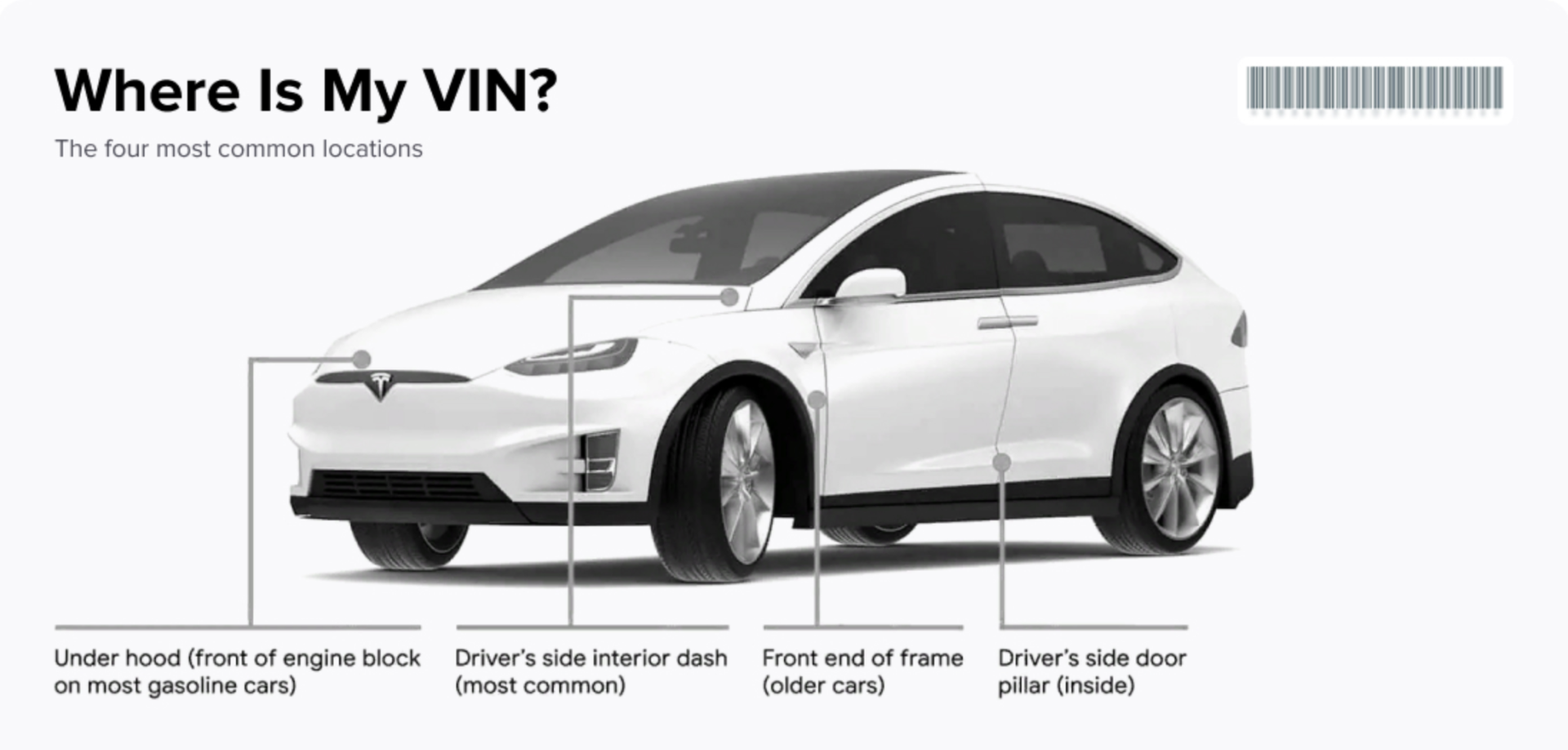
- Through the windscreen: a plate on the dashboard at the bottom of the windscreen, usually on the driver’s side. In the US, cars and light trucks must have a VIN that can be read from outside through the glass (49 CFR 565.13(f)).
- Door frame: a label on the door pillar, often on the driver’s side.
- Chassis or body: stamped into the metal, often under the bonnet near the bulkhead, under a flap in the floor by a front seat, or near a front suspension mount. The location varies by maker, and some stamp it in more than one place.
- Paperwork: the registration document (the V5C in the UK), insurance documents and the service record.
When you buy a used car, check that the VIN on the registration document matches the one on the windscreen plate, the door label and the chassis stamp. A mismatch is a reason to walk away until it’s explained.
VIN scanning
Typing 17 characters by hand is slow and easy to get wrong, so many vehicles also carry the VIN as a barcode, usually on the door pillar label and sometimes beside the windscreen plate. Older labels tend to use a one-dimensional barcode such as Code 39; newer ones often use a 2D code such as Data Matrix or QR. Phone apps and handheld scanners can read the barcode, or read the printed characters straight off a photo, and then run the check digit to catch misreads.
For a lender funding dealer stock, the VIN is what links a car on the forecourt to a line in the funded book. CheckVentory Auditor reads the VIN from a photo taken live during a dealer audit, records where and when the photo was taken, and matches the VIN against the funded book. A funded car that isn’t found, or a VIN that doesn’t match, shows up as an exception for the credit team to follow up.
What a VIN is used for
- Registering and taxing a vehicle, and linking it to its number plate.
- Safety recalls: manufacturers list affected vehicles by VIN.
- Insurance, accident records and repair work, including ordering the right parts.
- Vehicle history and theft checks before buying a used car.
- Stock audits: dealers and their funders use the VIN to confirm that a specific funded vehicle is where it should be.

VIN questions people ask
What is a VIN number?
A VIN (vehicle identification number) is a 17-character code that identifies one vehicle. Characters 1–3 identify the manufacturer, 4–9 describe the vehicle, and 10–17 identify the individual car, including in North America its model year, plant and serial number.
What is the world manufacturer identifier (WMI)?
The WMI is the first three characters of the VIN. It identifies the manufacturer and the region and country the maker is registered in, for example WBA for BMW in Germany or TMB for Škoda in the Czech Republic. National authorities assign WMIs under ISO 3780, and SAE International coordinates them worldwide.
What does the 8th character in a VIN mean?
It depends on the manufacturer. The 8th character belongs to the vehicle descriptor section, which each maker codes its own way. Many North American makers use it for the engine type, but you need the maker’s decoding data, or a decoder such as NHTSA’s, to read it for certain.
How do I tell a car’s year from the VIN?
Look at the 10th character. On North American vehicles it is the model year code: for example, S is 2025, T is 2026 and V is 2027. Codes repeat every 30 years, and the 7th character tells the cycles apart (a letter means 2010–2039). Outside North America the 10th character is often, but not always, the year.
Is the chassis number the same as the VIN?
On modern cars, yes: the VIN is the number stamped on the chassis, and the terms are used interchangeably. Older vehicles and some imports carry a shorter chassis or frame number that isn’t a 17-character VIN.
What does a VIN starting with 6ZZ mean?
6ZZ isn’t a carmaker. It is used for VINs that the Australian Government issues to imported vehicles that arrive without a valid 17-character VIN, so they can be registered in Australia.
Why do some VINs have a 9 as the third character?
A 9 in position 3 marks a small manufacturer: under 500 vehicles a year under EU rules and ISO 3780, or under 1,000 of a type a year in the US. These makers are identified by positions 1–3 together with positions 12–14.
Run a dealership?
Find the cars you’ve sold but are still paying floor plan on. LotCount scans the VIN on every car on the lot and checks it against your DMS and your floor plan statement, so you close month-end on a number you’d sign.