

Quick answer
WLTP stands for Worldwide Harmonised Light Vehicles Test Procedure (spelt “harmonized” in US English), the lab test that replaced the NEDC (New European Driving Cycle) as the way official fuel consumption, CO2 emissions and electric range are measured for new cars in Europe.
It was developed under the United Nations vehicle regulations forum (UNECE WP.29) and adopted as Global Technical Regulation No. 15 in March 2014. The EU wrote it into law through Commission Regulation (EU) 2017/1151, and it has applied to every new car registered in the EU since 1 September 2018. The UK, Norway, Switzerland and several other markets use it too, some in modified form. The US doesn’t; it has its own EPA tests.
What WLTP means in practice
When a brochure, price list or online listing quotes a car’s mpg, litres per 100 km, CO2 in g/km or electric range, that figure comes from the WLTP test. “WLTP mileage” or “WLTP range” simply means the official number the car achieved in that lab procedure. It’s a standard yardstick for comparing cars, not a promise of what you’ll get on your own commute.
How the WLTP test works
The car is driven on a rolling road in a temperature-controlled lab, following a fixed speed trace called the WLTC (Worldwide harmonised Light vehicles Test Cycle). There are three cycle classes, chosen by the car’s power-to-mass ratio. Almost all modern cars fall into Class 3, which has four phases:
| Phase | Duration | Distance | Top speed |
|---|---|---|---|
| Low | 589 s | 3.1 km | 56.5 km/h |
| Medium | 433 s | 4.8 km | 76.6 km/h |
| High | 455 s | 7.2 km | 97.4 km/h |
| Extra high | 323 s | 8.3 km | 131.3 km/h |
| Total | 1,800 s (30 min) | 23.3 km | 131.3 km/h |
Gear-change points are worked out for each vehicle rather than fixed. The test also accounts for optional equipment that changes weight, aerodynamics or rolling resistance, such as bigger wheels or a roof rack, so two versions of the same model can carry different official figures. European rules add a correction for cooler conditions, based on an extra test at 14°C.

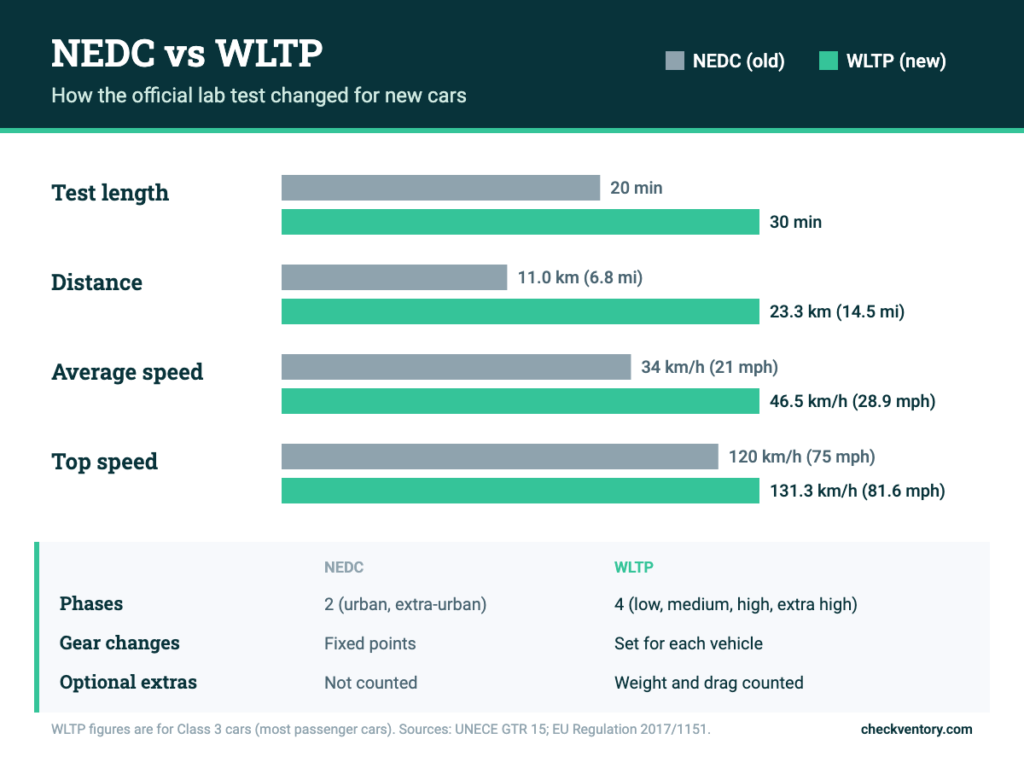
WLTP vs NEDC
The NEDC had been used in Europe since the early 1990s. Its gentle, steady speed profile bore little resemblance to real driving, and the gap between official and real-world fuel consumption kept widening. The 2015 diesel emissions scandal added political pressure, although that was mostly about NOx on the road, which is what RDE (below) was built to catch.
| NEDC | WLTP (Class 3) | |
|---|---|---|
| Duration | 1,180 s (about 20 min) | 1,800 s (30 min) |
| Distance | About 11 km | 23.3 km |
| Average speed | About 34 km/h | About 46.5 km/h |
| Top speed | 120 km/h | 131.3 km/h |
| Phases | 2 (urban, extra-urban) | 4 (low, medium, high, extra high) |
| Gear changes | Fixed points | Set per vehicle |
| Optional equipment | Not counted | Counted |
What WLTP means for fuel consumption, CO2, EV range and tax
Because the test is longer, faster and harder, the same car usually shows higher fuel consumption and CO2 under WLTP than it did under NEDC, and electric cars show a shorter official range.
WLTP covers electric and hybrid cars as well. An electric car gets an official range and energy use in kWh/100 km. A plug-in hybrid gets an electric-only range and a weighted CO2 figure that assumes a share of driving on battery.
Higher CO2 figures matter wherever tax is based on emissions, so governments had to decide when to switch. The UK moved vehicle tax for newly registered cars to WLTP figures on 1 April 2020, with company car tax following on 6 April 2020. EU fleet CO2 targets for manufacturers moved to WLTP-based values from 2021.
RDE: real driving emissions
WLTP is still a lab test. RDE runs alongside it: the car is driven on public roads, across a mix of urban, rural and motorway driving, with portable measuring equipment strapped to it. RDE checks pollutants such as NOx and particle numbers, which must stay within the legal limit plus an allowed margin. It became mandatory for new car types in September 2017 and for all new cars in September 2019.
WLTP key dates
- March 2014: UNECE WP.29 adopts GTR No. 15.
- 1 September 2017: WLTP and RDE required for new car types in the EU.
- 1 September 2018: WLTP required for all new cars registered in the EU.
- 1 September 2019: WLTP for all new larger vans (N1 classes II and III); RDE for all new cars.
- April 2020: UK vehicle tax and company car tax switch to WLTP figures.
- 2021: EU manufacturer CO2 targets based on WLTP.
- 29 November 2026: Euro 7 applies to new car and van types.
- 29 November 2027: Euro 7 applies to all new cars and vans.
Where WLTP stands in 2026
WLTP is still the test behind every official figure on a new car in Europe, but the rules around it keep moving. From 2025, the EU changed how plug-in hybrid results are weighted, which raised their official CO2 figures, and a further step is due in 2027. Euro 7 (Regulation (EU) 2024/1257) keeps WLTP and RDE and adds limits on brake particle emissions and minimum battery durability requirements for electric and plug-in hybrid cars.
What the 2018 deadline did to dealer stock
For a floorplan funder, the WLTP deadline showed how fast a rule change can reshape the stock you’re lending against.
From 1 September 2018, a new car without WLTP approval generally couldn’t be registered, apart from a limited end-of-series allowance. Not every version was re-tested in time, so manufacturers and dealers registered NEDC-approved stock before the cut-off. ACEA figures show EU new car registrations up 31.2% in August 2018, then down 23.5% in September. ACEA also noted that some manufacturers offered pre-WLTP cars at very attractive prices.
Many of those cars came back onto forecourts as pre-registered stock: technically used, carrying a registration date, and sold as nearly new. For a funder, that raises a few practical questions:
- A registration isn’t a sale. A dealer can register a car to itself and keep it in stock. The unit is still there and still funded, but its status has changed.
- The value can change overnight. A pre-registered car is a used car on paper, so the value you lent against may not hold.
- Unusual movements need an explanation. A burst of registrations at one dealer, or a block of units changing status at once, is worth understanding before the next scheduled visit, not after it.
- Rushed stock can age. Cars registered to beat a deadline still have to find a buyer.
Euro 7 and the plug-in hybrid changes are the next rules of this kind, so the same questions apply.
WLTP FAQ
What is the full form of WLTP?
Worldwide Harmonised Light Vehicles Test Procedure (Worldwide Harmonized Light Vehicles Test Procedure in US spelling).
What does WLTP stand for in cars?
It’s the official lab test used to measure a new car’s fuel consumption, CO2 emissions and electric range. The mpg, g/km and range figures in brochures and listings come from it.
What is the difference between WLTP and NEDC?
WLTP replaced NEDC. Its test cycle runs for 30 minutes instead of about 20, covers 23.3 km instead of about 11, reaches 131.3 km/h instead of 120 and counts optional equipment. The result is official figures closer to real driving.
Does WLTP apply to electric cars?
Yes. Electric cars get an official WLTP range and energy consumption figure, and plug-in hybrids get an electric-only range and a weighted CO2 figure.
To see how funders track stock changes like these unit by unit, look at our sample audit record or book a demo.